


I. Working Principle
 PSA Nitrogen Generator from air under a certain pressure based on the Pressure Swing Adsorption (PSA) principle, using high-quality carbon molecular sieve (CMS) as the adsorbent. After purification and drying, the compressed air undergoes pressurized adsorption and depressurized desorption in the adsorber. Due to the aerodynamic effect, the diffusion rate of oxygen in the micro-pores of the carbon molecular sieve is much faster than that of nitrogen-oxygen is preferentially adsorbed by the carbon molecular sieve, while nitrogen is enriched in the gas phase to form finished nitrogen. Subsequently, the pressure is reduced to atmospheric pressure, and the adsorbent desorbs the adsorbed impurities such as oxygen to achieve regeneration.
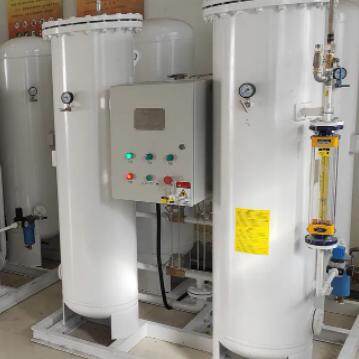
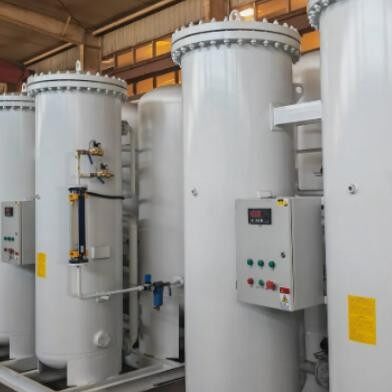
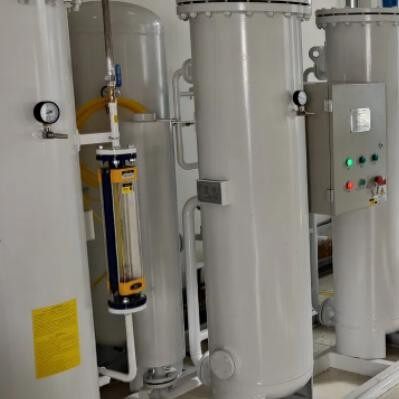
Typically, two adsorption towers are installed in the system: one tower performs adsorption to produce nitrogen, while the other undergoes desorption for regeneration. The PLC (Programmable Logic Controller) controls the opening and closing of pneumatic valves to enable alternate cycling of the two towers, thereby achieving the continuous production of high-quality nitrogen.
II. System Process of PSA Nitrogen Generator
The entire system consists of the following components: compressed air purification module, air storage tank, oxygen-nitrogen separation unit, and nitrogen buffer tank.
1. Compressed Air Purification Module
First, the compressed air supplied by the air compressor is introduced into the compressed air purification module. A pipeline filter first removes most of the oil, water, and dust from the compressed air; then a refrigerated dryer further removes water, a precision filter removes oil and dust, and an ultra-precision filter (installed immediately afterward) performs deep purification.
According to the system operating conditions, a dedicated compressed air oil remover is specially designed to prevent potential micro-oil penetration, providing full protection for the carbon molecular sieve. The well-designed compressed air purification module ensures the service life of the carbon molecular sieve. The clean air treated by this module can be used as instrument air.
2. Air Storage Tank
The functions of the air storage tank are as follows:
- Reduce air flow pulsation and play a buffering role;
- Minimize system pressure fluctuations, allowing compressed air to flow smoothly through the compressed air purification module to fully remove oil and water impurities, thereby reducing the load on the subsequent PSA oxygen-nitrogen separation unit;
- When the adsorption towers switch operations, it provides a large amount of compressed air required for the rapid pressure rise of the PSA oxygen-nitrogen separation unit in a short period, enabling the pressure inside the adsorption towers to quickly rise to the working pressure and ensuring the reliable and stable operation of the equipment.
3. Oxygen-Nitrogen Separation Unit

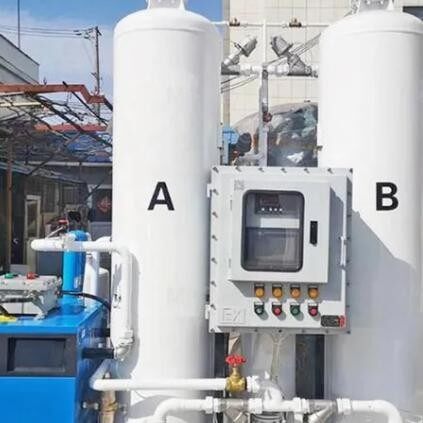
There are two adsorption towers (Tower A and Tower B) filled with dedicated carbon molecular sieve. When clean compressed air enters the inlet end of Tower A and flows toward the outlet end through the carbon molecular sieve, O₂, CO₂, and H₂O are adsorbed, and the product nitrogen flows out from the outlet end of the adsorption tower. After a certain period, the carbon molecular sieve in Tower A becomes saturated with adsorption.
At this point, Tower A automatically stops adsorption, and compressed air flows into Tower B for oxygen adsorption and nitrogen production, while the molecular sieve in Tower A is regenerated. Regeneration of the molecular sieve is achieved by rapidly reducing the pressure of the adsorption tower to atmospheric pressure to desorb the adsorbed O₂, CO₂, and H₂O. The two towers alternately perform adsorption and regeneration to complete oxygen-nitrogen separation and continuously output nitrogen.
All the above processes are controlled by a PLC (Programmable Logic Controller). When the nitrogen purity at the outlet end is lower than the set value, the PLC program is activated, and the automatic vent valve opens to automatically vent the substandard nitrogen, ensuring that no substandard nitrogen flows to the gas consumption point. A muffler is used to muffle the noise during gas venting, keeping the noise below 75 dBA.
4. Nitrogen Buffer Tank
The nitrogen buffer tank is used to balance the pressure and purity of the nitrogen separated from the oxygen-nitrogen separation system, ensuring the continuous and stable supply of nitrogen. Meanwhile, after the adsorption towers switch operations, it refills part of its gas into the adsorption towers-this not only helps the adsorption towers increase pressure but also protects the bed layer, playing a crucial auxiliary role in the equipment's working process.
III. Technical Indicators of PSA Nitrogen Generator
- Flow Rate: 3-3000 Nm³/h (normal cubic meters per hour)
- Purity: 95%-99.999%
- Dew Point: ≤-40℃
- Pressure: ≤0.6 MPa (adjustable)
IV. Technical Features
- Rational internal components ensure uniform air flow distribution and reduce the high-speed impact of air flow.
- Improved process design delivers optimal application effects.
- Unique molecular sieve protection measures extend the service life of the carbon molecular sieve.
- Intelligent interlocked substandard nitrogen venting device guarantees the quality of product nitrogen.
- Optional configurations include automatic nitrogen flow and purity adjustment systems, as well as remote control systems.
- Easy operation, stable operation, high degree of automation, and support for unattended operation.
V. PSA Nitrogen Generator Application Fields

- Electronics Industry: Nitrogen protection for the production of semiconductors and electronic components.
- Heat Treatment: Bright annealing, protective heating, sintering of powder metallurgy and magnetic materials, etc.
- Food Industry: Equipped with a sterilizing filter, it can be used for nitrogen-filled packaging, grain storage, fresh-keeping of fruits and vegetables, and preservation of wines and beverages.
- Chemical Industry: Nitrogen blanketing, displacement, cleaning, pressure conveying, chemical reaction agitation, protection for chemical fiber production, etc.
- Oil and Gas Industry: Oil refining, nitrogen-filled purging and leak detection for containers and pipelines, nitrogen injection for oil recovery.
- Pharmaceutical Industry: Nitrogen-filled storage of Chinese and Western medicines, pneumatic conveying of medicinal materials, etc.
- Cable Industry: Protective gas for cross-linked cable production.
- Others: Metallurgical industry, rubber industry, aerospace industry, etc.
The purity, flow rate, and pressure are stable and adjustable to meet the needs of different customers.
In addition to PSA Nitrogen Generators, we also produce PSA Oxygen Generator, storage tanks, heat exchangers and other products. If you are interested in VPSA Oxygen Systems or other products, please feel free to send an email to sales@gneeheatex.com. We will be very happy to serve you.


