


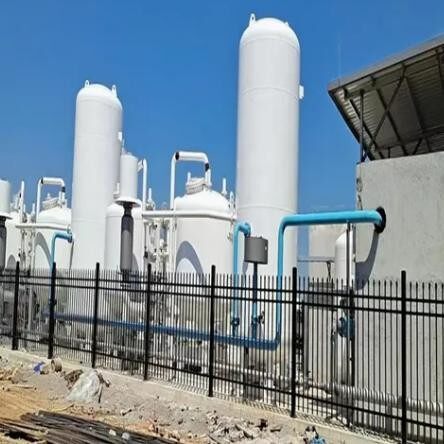

Products Description
 A VPSA (Vacuum Pressure Swing Adsorption) oxygen generator is a complete set of equipment that produces oxygen and industrial gases using air as the raw material. It belongs to a branch of Pressure Swing Adsorption (PSA) technology and is mainly applied in metallurgy, chemical industry, environmental protection, healthcare, and aquaculture.
The core process involves feeding compressed air through a blower, and regenerating the adsorbent using a vacuum pump. By utilizing the selective adsorption of nitrogen by zeolite molecular sieves, the system achieves oxygen-nitrogen separation.
Compared with conventional PSA processes, VPSA operates at a lower pressure, featuring:
- Low energy consumption: power consumption of 0.32–0.6 kWh/Nm³
- Flexible capacity: oxygen production ranging from 50–20,000 Nm³/h
- Adjustable purity: oxygen concentration ranging from 30–95%
VPSA Oxygen System Parameters
|
Oxygen yield |
Load adjustment range |
Water Consumption |
Power Consumption |
Plot area |
|
1000 Nm3/h |
50%~100% |
30 |
468 |
|
|
3000 Nm3/h |
50%~100% |
70 |
572 |
|
|
5000 Nm3/h |
50%~100% |
121 |
648 |
|
|
8000 Nm3/h |
25%~100% |
205 |
1350 |
|
|
10000 Nm3/h |
25%~100% |
242 |
1350 |
|
|
12000 Nm3/h |
25%~100% |
258 |
1508 |
|
|
15000 Nm3/h |
17%~100% |
363 |
1890 |
|
|
18000 Nm3/h |
17%~100% |
387 |
2088 |
|
|
20000 Nm3/h |
13%~100% |
482 |
2800 |
Working Principle of VPSA Oxygen Generation
The working principle of a VPSA (Vacuum Pressure Swing Adsorption) oxygen generation system is primarily based on the differences in the adsorption characteristics of molecular sieves toward different gas molecules. Under low-pressure conditions, the molecular sieve adsorbent selectively adsorbs nitrogen, carbon dioxide, water vapor, and other impurities from the air. Oxygen, by contrast, passes through the adsorption bed and is collected at the top of the adsorption tower as the product gas.
When the adsorbent approaches saturation, the system applies a vacuum regeneration process to desorb the saturated molecular sieve. In this stage, nitrogen is released through the exhaust outlet, thus completing one full adsorption–desorption cycle.
Technical Features of VPSA Oxygen Generation Systems
 High Efficiency
VPSA oxygen generation systems adopt advanced pressure swing adsorption technology, enabling rapid and efficient oxygen separation under varying pressure conditions. This meets the urgent oxygen demand of various industries.
Energy-Saving and Environmentally Friendly
Compared with conventional oxygen production methods, VPSA systems operate with significantly lower energy consumption and generate minimal exhaust gases. This results in reduced environmental impact and aligns with the principles of green, low-carbon, and sustainable development.
Ease of Operation
The equipment is designed with user-friendly interfaces and is equipped with advanced automated control systems. These systems provide real-time monitoring of operational status, ensuring stable and safe performance.
Application Fields of VPSA Oxygen Generation Systems
Industrial Applications
Industries such as steelmaking, nonferrous metallurgy, chemical processing, and glass manufacturing require large quantities of oxygen. VPSA oxygen systems provide a stable and efficient oxygen supply, improving production efficiency while reducing energy consumption.
 Environmental Protection
In wastewater treatment plants and landfill sites, oxygen injection enhances microbial activity, accelerating the decomposition of organic matter. This reduces pollutant discharge and contributes to the harmless treatment of waste gases.
Oxy-Fuel Combustion
In certain combustion processes, introducing oxygen increases combustion efficiency and reduces the generation of harmful byproducts. The high-purity oxygen supplied by VPSA systems is well-suited for oxy-fuel combustion technologies, improving energy utilization efficiency.
Scientific Research
Laboratories and research institutions require reliable and stable oxygen sources. VPSA oxygen systems provide dependable oxygen supply for experimental and scientific applications, supporting technological innovation and progress.
Differences Between VPSA and PSA Oxygen Generators
Oxygen generators are modern equipment widely used to separate oxygen from air.
VPSA (Vacuum Pressure Swing Adsorption) and PSA (Pressure Swing Adsorption) are two commonly applied oxygen generation technologies.
Although both are based on the principle of adsorption, they differ significantly in terms of operating mechanisms, energy consumption, efficiency, and application suitability.
Working Principle
- VPSA Oxygen Generator:
VPSA technology separates oxygen by varying the adsorption pressure applied to the adsorbent. Under high pressure, the adsorbent selectively adsorbs nitrogen and other impurities. Under low (vacuum) pressure, these gases are released, achieving oxygen enrichment.
- PSA Oxygen Generator:
PSA technology separates nitrogen and oxygen by cyclically changing the pressure of the adsorption bed. During the adsorption stage, nitrogen is adsorbed by the adsorbent, while during the desorption stage, nitrogen is released and oxygen is collected.
Energy Consumption and Efficiency
- VPSA:
Because VPSA employs vacuum pressure swing adsorption, its energy consumption is lower compared to PSA, resulting in more economical operation.
- PSA:
Since PSA requires frequent pressurization and depressurization, its energy consumption is relatively higher.
Oxygen Purity and Output
- VPSA:
VPSA systems typically deliver higher oxygen purity, making them suitable for applications with stricter purity requirements.
- PSA:
While PSA can also produce high-purity oxygen, in certain applications its purity may be slightly lower than that achieved by VPSA.
Equipment Maintenance and Operation
- VPSA:
VPSA systems generally feature simpler equipment structures, leading to lower maintenance costs and stable, reliable operation.
- PSA:
Due to the need for frequent pressure changes, PSA systems require higher sealing performance and durability, which can increase maintenance costs.
Application Fields
- VPSA:
With its low energy consumption, high efficiency, and stable operation, VPSA technology is widely applied in industries such as metallurgy, energy, and chemical processing. It is particularly advantageous in scenarios that demand continuous oxygen supply.
- PSA:
PSA technology is also suitable for industrial applications. However, in cases requiring high purity, high output, or uninterrupted oxygen supply, VPSA may offer a more ideal solution.
Environmental Impact
- VPSA:
VPSA oxygen generation produces relatively fewer exhaust gases, resulting in minimal environmental impact.
- PSA:
While PSA is also considered an environmentally friendly technology, its waste gas management performance is generally less efficient than that of VPSA.
If you want to learn more about GNEE's products, you can send an email to sales@gneeheatex.com. We are more than happy to assist you.
FAQ
Q: What is your main product ?
A: Oxygen gas plant
Q: How to get a prompt quotation?
A: When you send us inquiry, please kindly tell us the below technical information.
1) O2 Production capacity: ____Nm3/h
2) O2 Purity: ____%
3) O2 Discharge pressure: ____Bar
4) Local Voltages and Frequency: _____V/PH/HZ
5) Application or use for which industry:_____(industrial use or medical use,etc)
6) Altitude and atmospheric conditions:_____m
Q: Standard requirements for special equipment execution?
A: GB or ASME /Others
Q: How do you pack the product before delivery?
A: We packed in accordance with the export standards.
Q: What about order process?
A: a. Inquiry---provide us all clear requirements.
b. Quotation---official quotation form with all clear specifications.
c. Contract confirmation---provide correct contract details.
d. Payment terms
e. Production
f. Shipping
g. Installation and commissioning
Q: Terms of payment?
A: We have flexible and active payment terms.
Q: Which payment terms you can accept?
A: We can accept flexible payment include Bank Transfer, LC, DP, West Union, Paypal, or Combination terms as negotiation.
Q: Can you do OEM and ODM?
A: Yes, OEM and ODM are both available for us. With the requirements customization of the material, colors, style, the basic quantities will be advised after we discussed together.


