

PSA nitrogen generators for these scientific applications are designed to produce high purity nitrogen by regulating gas adsorption and adsorbent regeneration by changing pressures in two adsorber-adsorbent containing vessels. This process requires a constant temperature, close to ambient.
The swing adsorption process in each of the two adsorbers consists of two stages running at intervals of a few minutes. At the adsorption stage oxygen, moisture and carbon dioxide molecules diffuse into the pore structure of the adsorbent whilst the nitrogen molecules are allowed to travel through the adsorber–adsorbent-containing vessel to be delivered as high purity nitrogen to the application.
Two tower system

PSA traps oxygen from the compressed air stream when molecules bind themselves to a carbon molecular sieve. This happens in two separate pressure vessels (tower A and tower B). Each of these is filled with a carbon molecular sieve that switches between a separation and regeneration process.
Clean, dry compressed air enters tower A. Since oxygen molecules are smaller than nitrogen molecules, they pass through the pores of the sieve. Nitrogen molecules cannot fit through the pores so they bypass the sieve. This results in nitrogen of desired purity. It is called the adsorption or separation phase.
Most of the nitrogen produced in tower A exits the system ready for direct use or storage. Next, a small portion of generated nitrogen flows into tower B in the opposite direction. This flow pushes out the oxygen that was captured in the previous adsorption phase by tower B.
By releasing the pressure in tower B, the carbon molecular sieves lose their ability to hold the oxygen molecules. These detach from the sieves and get carried away by the small nitrogen flow coming from tower A.
This "cleaning" process makes room for new oxygen molecules to attach to the sieves in the next adsorption phase. The two-tower PSA system switches between separation and regeneration to provide continuous nitrogen production at a desired purity level.
Industrial applications of nitrogen generators
Nitrogen is widely applied in industry because it is inert, odourless, and prevents oxidation. An on-site generator supplies nitrogen at the right purity and flow, reducing reliance on bottled deliveries while ensuring a stable gas supply.
 Key applications include:
Chemical processing: nitrogen is used to create inert conditions that prevent explosions or unwanted reactions. A nitrogen generator in the chemical industry allows operators to maintain safety while reducing gas procurement costs.
Food and beverage production: controlled atmospheres help extend shelf life and preserve flavour. In packaging lines, a nitrogen generator for the food industry flushes oxygen from packets, while in a beverage factory, nitrogen protects liquids during bottling and storage.
Automotive sector: nitrogen-filled tyres maintain pressure for longer and reduce oxidation of the rubber. Using a nitrogen generator for tires ensures a reliable supply for service centres and fleet operators.
In short, when asking "What is a nitrogen generator used for?", the answer covers a wide spectrum, from laboratories and plastics to aquaculture and pharmaceuticals, anywhere an oxygen-free or low-oxygen environment is required.
Advantages of on-site nitrogen generation
Producing nitrogen in-house gives companies direct control over output, purity, and pressure. Beyond flexibility, there are significant operational and financial advantages compared to relying on external suppliers.
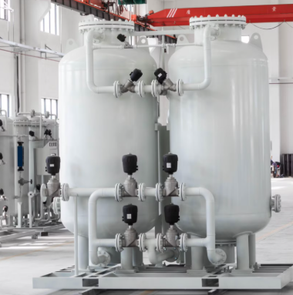
Key benefits include:
Cost stability: independence from market price fluctuations for bottled or bulk nitrogen.
Lower logistics costs: no transport fees, delivery scheduling, or return handling of cylinders.
Safety improvements: eliminates the risks of storing and handling high-pressure bottles.
No waste: avoids boil-off losses from liquid tanks and unused residual gas in cylinders.
Reliability: continuous supply available around the clock, reducing risk of production downtime.
Long-term savings: while the equipment requires upfront investment, operating costs are significantly lower over time.
These factors make on-site nitrogen generation not only a technical solution but also a way to improve safety, efficiency, and cost management in daily operations. Read more about the benefits of onsite nitrogen generation.
Choosing the right nitrogen generator
Every application has different needs when it comes to nitrogen flow, purity, and operating conditions. The right system ensures efficiency, safety, and long-term cost savings. For some industries, a compact membrane generator may be sufficient, while others require the ultra-high purity delivered by PSA technology.
In addition to PSA Nitrogen Generator, we also produce VPSA Oxygen Generators,PSA Oxygen Generators, storage tanks, heat exchangers and other products. If you are interested in psa nitrogen Systems or other products, please feel free to send an email to sales@gneeheatex.com. We will be very happy to serve you.
FAQ
What is a PSA nitrogen generator?
PSA stands for pressure swing adsorption. It is a technology that can be used to generate nitrogen or oxygen for professional purposes. First, tank A is in the adsorption phase while tank B regenerates. In the second stage both vessels equalize pressure to prepare for the switch.
Who is the manufacturer of PSA nitrogen generator?
GNEE is China Manufacturer of PSA Nitrogen Gas Plants. Welcome to GNEE. GNEE is China's manufacturer of high-quality On-Site PSA Nitrogen Gas Generator Plants.
What is the difference between PSA and membrane nitrogen generator?
Membrane technology is ideal for low-purity applications, while PSA technology can produce higher-purity nitrogen. Both technologies offer cost-effective and reliable solutions for nitrogen generation in various industries.
What is PSA in gasification?
Pressure swing adsorption (PSA) is a fully developed and commercialized technology for gas separation which consists of the selective adsorption of a gas in an adsorbent material. This material has the capacity to selectively adsorb and desorb the gas depending on the operating pressure.
What is the working principle of PSA?
The Principle of Pressure Swing Adsorption (PSA) Technology
In pressure swing adsorption, specialised adsorbent materials adsorb the gas molecules such as oxygen, carbon dioxide, water vapour and other gases under high pressure with the exception of nitrogen
What is the lifespan of a nitrogen generator?
PSA nitrogen generators are typically designed with an equipment life cycle of 20 to 25 years. Membrane nitrogen generators also have a long life cycle. Some manufacturer's membranes can last up to 15 years before replacement is required.
What is a PSA generator?
PSA stands for pressure swing adsorption. It is a technology that can be used to generate nitrogen or oxygen for professional purposes. First, tank A is in the adsorption phase while tank B regenerates. In the second stage both vessels equalize pressure to prepare for the switch.
How does the PSA system work?
The pressure swing adsorption (PSA) process is based on the phenomenon that under high pressure, gases tend to be trapped onto solid surfaces, i.e. to be "adsorbed". The higher the pressure, the more gas is adsorbed. When the pressure is dropped, the gas is released, or desorbed.
|
Model Name |
Nitrogen Purity |
Production(Nm³/h) |
Air Consumption(Nm³/h) |
|
|
PSA-5 |
95%-99.999% |
5 |
15 |
|
|
PSA-20 |
95%-99.999% |
20 |
58.2 |
|
|
PSA-60 |
95%-99.999% |
60 |
174 |
|
|
PSA-100 |
95%-99.999% |
100 |
279 |
|
|
PSA-200 |
95%-99.999% |
200 |
547.2 |
|
|
PSA-400 |
95%-99.999% |
400 |
1105.2 |
|
|
Customize |
95%-99.999% |
Customize |
Customize |
|